Just Because You Can Make It, Doesn’t Mean It Makes a Difference
Updated: Apr 14, 2025
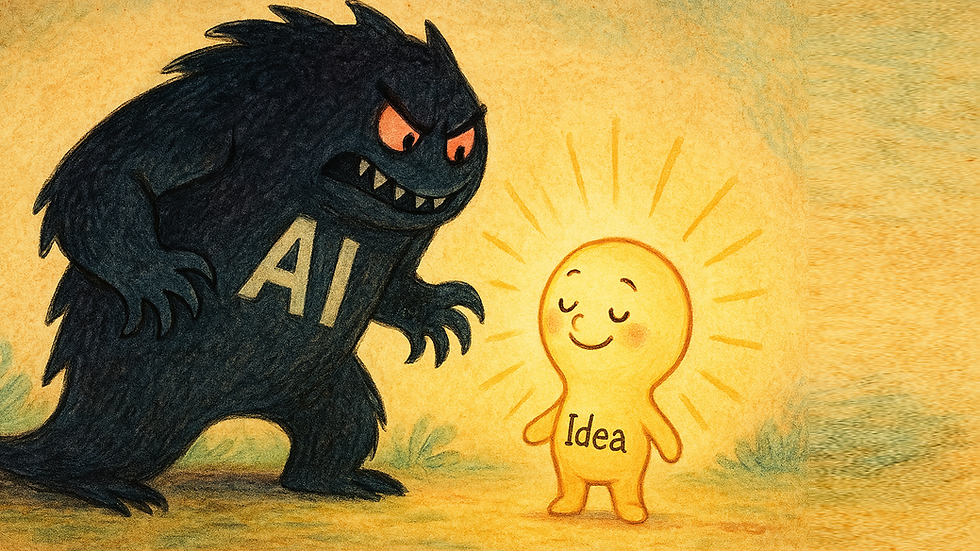
We’re living through a defining moment in content production. Thanks to generative AI, the cost of creating visually polished content—be it images, videos, or fully-rendered scenes—has dropped to near zero. What once required production teams, expensive hardware, and industry connections can now be executed by a single person with a prompt and a laptop.
This democratization of content is seismic. But let’s not confuse production power with delivering impact.
Yes, the traditional barriers to creation are gone. But as anyone who’s doom-scrolled through a feed of beautifully rendered, instantly forgettable posts knows: just being able to create content doesn’t mean it will matter.
We’re entering the Age of Mediocrity—an era defined not by a lack of content, but by a lack of distinction.
The False Promise of Unlimited Content
For decades, high-quality production was a moat. It protected the gatekeepers. If you wanted to launch a brand campaign, shoot a commercial, or produce a music video, you needed the three C’s: capital, crew, and connections. That moat is now evaporating.
With AI tools now in nearly every creator’s toolkit, the ability to make “good-enough” content is table stakes. But here’s the catch: good enough is everywhere. And in a sea of sameness, good enough becomes invisible.
The Age of Mediocrity isn’t built on failure. It’s built on content that looks fine, says nothing, and disappears.
History Rhymes: Lessons from the Music Industry
We’ve seen this kind of disruption before.
Pre-Napster, pre-Spotify, producing an album meant booking expensive studio time and signing with a label for distribution. The record industry was a closed loop—and wildly profitable.
Then came consumer-grade recording software, streaming platforms, and the rise of the social artist. Suddenly, a kid in a bedroom could write, record, distribute, and promote music globally.
Take Lil Nas X and Old Town Road. Created with a cheap beat off BeatStars and marketed with meme fluency on TikTok, it became the longest-running Billboard No. 1 single ever.
It wasn’t a polished studio project. It was a cultural moment. A great idea, brilliantly timed, natively distributed.
The lesson? Tools disrupt industries. Ideas disrupt culture.
The Coming Shake-Up in Content Production
Content seems to be following music’s playbook.
Studios, agencies, and legacy production houses—many of them built on access to expensive tools and legacy networks—will face pressure to evolve or justify their relevance.
Taking their place are AI-native creators, lean content studios, and brands that think in real time. These aren’t budget replacements—they’re concept powerhouses with a creator’s instinct and a strategist’s eye.
Look at Karen X Cheng. She’s a one-woman idea machine who blends AI tools like Runway, Midjourney, and ElevenLabs into visually arresting content. Her viral deepfakes, 3D design experiments, and cultural remixes aren’t just AI showcases—they’re moments of creative insight dressed in pixels.
Her real edge is to instinctively understand what the internet cares about and when. AI doesn’t give her that—it just helps her scale it.
What Still Matters (and Always Will)
The mediums are evolving. The economics have flipped. The barriers are gone.
But the fundamentals still remain untouched.
To make content that matters, you still need:
A fresh perspective
A compelling story
Cultural and contextual relevance
Strategic timing
Duolingo’s TikTok. It’s not glossy. It’s not expensive. But it works. Duo, the unhinged owl mascot, has become a full-blown Gen Z influencer—flirting with Dua Lipa, dancing on desks, and dunking on users who miss their lessons.
What makes it effective isn’t the production—it’s the idea: irreverent, self-aware, perfectly in tune with platform culture. And it’s turned a language-learning app into a viral phenomenon.
Generative AI is a lever—but it’s not a vision.
It can scale execution, streamline workflows, and lower costs. But it can’t tell you why something matters, when it should land, or how it makes people feel.
Only the idea can do that.
So as the industry floods with cheap, fast, and technically impressive content, remember: the only real scarcity is relevance.
In an age where everyone can create anything, the rarest asset is still the idea that moves people.


Comments